
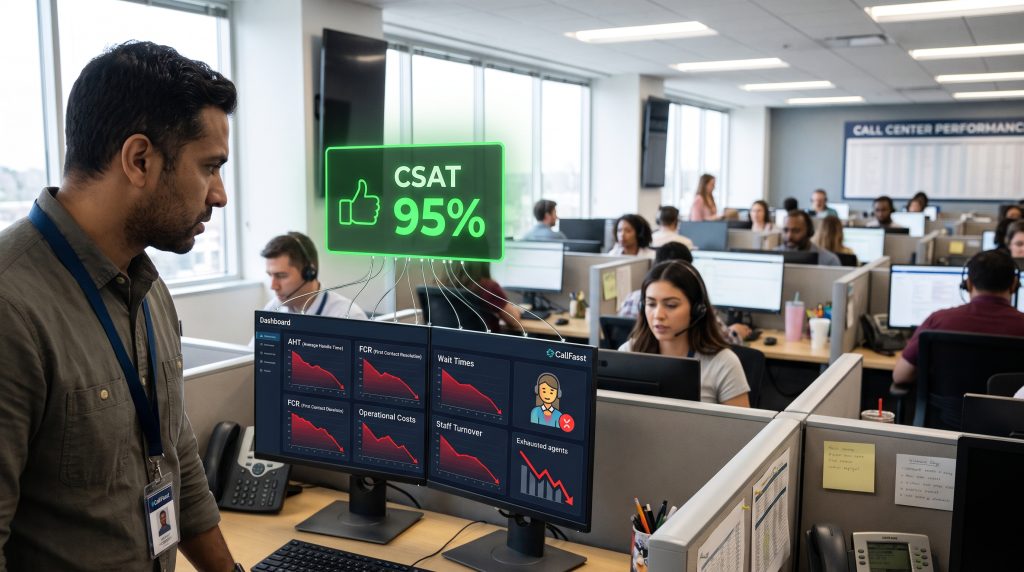
The Customer Satisfaction Trap in Contact Centers
As a specialized BPO contact center, we understand the critical importance of having accurate metrics that allow our clients to measure the performance of their phone agents and our overall operations. As we often discuss in our strategic reviews, one of the most widely used Key Performance Indicators (KPIs) across North America is the CSAT (Customer Satisfaction Score).
Because of its popularity, it is incredibly frustrating for a Chief Operating Officer (COO) or a Customer Experience (CX) leader when the metrics dashboard looks virtually flawless. Imagine this scenario: your CSAT is shining at a solid 88%, and even your Average Handle Times (AHT) look stable and perfectly aligned with industry benchmarks.
However, when you cross-reference this operational data with the Chief Financial Officer’s (CFO) reports, a starkly contrasting reality emerges. The retention rate is nosediving, customer churn is steadily increasing, and the Customer Lifetime Value (LTV) is shrinking month over month.
How is it possible that your customers claim to be “satisfied” in post-call surveys, yet simultaneously cancel their services, abandon their carts, and run straight to your competitors?
The answer lies in an operational blind spot affecting many companies in North America and the rest of the world: the 2010 Harvard Business Review article “Stop Trying to Delight Your Customers” demonstrated that KPIs can measure the friendliness of the interaction, but sometimes ignore the amount of friction in the process. Today, we’ll delve into the true predictor of customer loyalty for 2026: the
Customer Effort Score (CES) , and how to reduce the burden on your users.
The CSAT Mirage: Politeness vs. Actual Resolution
Let’s be clear: CSAT is a valuable tactical metric. It tells you if the agent who answered the phone was polite, if they used the correct tone of voice, and if they demonstrated empathy. When a customer rates a call with “5 out of 5 stars,” they are frequently grading the human being on the other end of the line. They feel empathy for the frontline worker who tried to help them.
But friendliness does not compensate for a broken process.
A customer might give a high CSAT score simply because your support agent was extremely courteous while explaining that “your issue needs to be escalated to another department and it will take 72 hours to resolve.” The customer expresses satisfaction with the human treatment, but underneath, they are deeply frustrated by the corporate effort required to get a simple fix.
This dangerous disconnect was famously proven in the landmark 2010 Harvard Business Review study, “Stop Trying to Delight Your Customers.” After analyzing more than 75,000 consumers, researchers uncovered a lethal reality for traditional CX strategies: trying to “delight” the customer by exceeding their expectations has almost zero impact on actual loyalty.
What truly drives loyalty and secures repeat purchases in fast-paced markets like the US and Canada? Making your customers’ lives easier.
You probably already know this, but how do you make it an operational reality?
Customer Effort Score (CES): The Metric That Predicts Real Loyalty
Born from that very HBR study, the Customer Effort Score (CES) fundamentally shifts how we measure success. This metric abandons the generic question of “How satisfied are you?” and replaces it with a much more revealing inquiry:
“How much effort did you have to put forth today for our company to resolve your issue?”
The data backing the impact of CES explains exactly why executives must integrate it into their North American dashboards immediately:
- Loyalty Destroyed: According to the aforementioned study, a staggering 96% of customers who report having made a “high effort” to resolve an issue become disloyal to the brand.
- Loyalty Guaranteed: In sharp contrast, only 9% of customers who experience a “low effort” interaction show signs of disloyalty.
- The Domino Effect: A consumer experience report by PwC (“Experience is Everything”) reinforces this by pointing out that 32% of US consumers will abandon a brand they love after just one single bad experience (a spike in friction). Interestingly, in Latin America, that number jumps to 49%, proving that frictionless service is a global necessity, but critical for the highly competitive US market.
The 3 Silent Killers of Customer Retention (and How to Eradicate Them)
To reduce customer effort, you must first identify exactly where friction is being generated within your contact center. Throughout our operational history auditing CX ecosystems, we have identified three main “silent killers” of retention:
1. The Endless Loop of Repeating Information
Nothing spikes a CES score into critical territory faster than forcing a user to repeat their story. According to recent CX trend surveys published by Zendesk, over 70% of consumers expect agents to have full context of their previous interactions.
If a customer initiates a complaint via live chat and then follows up with a phone call, forcing them to dictate their account number again and explain the problem from scratch is an unforgivable architectural flaw in today’s market.
2. Blind Channel Transfers (The Ping-Pong Effect)
Connecting a user from one department to another without passing the context of the call is another severe form of friction. The customer immediately perceives that the company operates in disconnected silos. A high-quality BPO must implement intelligent routing models and a unified omnichannel history to prevent the user from feeling like a ping-pong ball bouncing between departments.
3. The Digital Bureaucracy Maze
When a company’s policies require a user to send three emails, fill out a web form, and wait for a supervisor’s callback just to process a simple return, CSAT loses all relevance. Internal bureaucracy suffocates the experience. Customer effort multiplies exponentially when self-service technology (like an inefficient chatbot) fails to resolve the issue and offers no quick escape route to a human agent.
First Contact Resolution (FCR): The Strategic Antidote
Reducing customer effort requires reengineering the way you operate your support. As detailed in our internal documentation and strategic guidelines—including the comprehensive CallFasst_ blog 107 (C1).pages file—we have proven over our 27 years of experience managing international corporate contact centers that the ultimate antidote to a high CES is First Contact Resolution (FCR).
FCR measures exactly what the North American user desires: calling once, interacting with a single agent, and hanging up with the problem completely solved. To achieve FCR levels that exceed the industry average, we have implemented three key tactics in our operations:
1. Agent Empowerment (Resolutive Autonomy)
An agent reading a strict, inflexible script cannot solve atypical problems. We have dedicated areas where we train our monolingual and bilingual teams through deep cultural immersion. We give them the tools, the trust, and the authority necessary to make pro-customer decisions on the spot, without having to escalate every basic interaction to a supervisor.
2. Secure Technological Integration
For an advisor to resolve an issue rapidly, they need immediate access to data. Thanks to our ISO/IEC 27001:2022 certification, we integrate securely and seamlessly with our clients’ CRMs. When a call comes in, our agent already has the user’s purchase history and previous tickets on their screen, completely eliminating the “endless loop of repeating information.”
3. Frictionless Handoffs (AI to Human)
If a customer service bot runs out of answers, the transition to our human agents is immediate and contextual. The advisor picks up the conversation exactly where the Artificial Intelligence left off, reducing the customer’s effort to absolute zero.
The Nearshore Advantage: Why US & Canadian Brands Choose Mexico
When tackling high Customer Effort Scores, the geographical location of your BPO matters immensely. For years, US and Canadian companies outsourced to far-off offshore locations to cut costs, only to see their CES skyrocket due to heavy accents, cultural disconnects, and rigid script-reading that frustrated North American callers.
By partnering with a Nearshore BPO in Mexico like CallFasst, you eliminate these friction points entirely. Time zone alignment means your management teams can collaborate with ours in real-time. Deep cultural affinity ensures our bilingual agents understand US and Canadian colloquialisms, urgency, and customer expectations, delivering a seamless, low-effort experience that offshore alternatives simply cannot match.
From an “Apology Center” to a Loyalty Engine
Auditing your operation and integrating the Customer Effort Score into your executive dashboard will reveal the raw truth about your company’s customer experience.
By partnering with a strategic contact center BPO that prioritizes First Contact Resolution, cultural alignment, and agent empowerment, you will transform your support line from a simple “apology center” into a true retention engine, heavily armored against capital flight. Stop measuring smiles, and start eliminating friction.